Updated:
- The Why?
- Piece movement
- In check
- Special moves
- Pinned pieces
- Edge cases
- Checkmate & Stalemate detection
- Concluded game flow
- Try the demo
The why?
I’ve long been fascinated with the game of chess, and I’ve wanted to make my own chess engine for a while. In combination with another project idea, I decided I wanted a playable chess board in vanilla Minecraft, so you could play chess with your friends in everyone’s favorite sandbox game.
However, vanilla Minecraft has a lot of computational limitations that would make this challenging. Minecraft allows players to create data packs, which can contain scripts written in Minecraft’s own scripting language: mcfunction.
The goal of this blog post is to hopefully make it easier for new chess programmers to get a working efficient chess move validation engine without having to go through the same amount of research and debugging as me.
I believe this move validation algorithm is quite efficient and really simple to implement.
At the end of this article, I left an overview of the entire algorithm summarized.
”Static”?
In this case, with “static”, I mean to refer to creating a chess engine without simulating future board states. In the Minecraft environment I’m working with, recursion and branching is really hard and computationally expensive. So we need a move validator that considers only the current board state, without simulating future moves.
Piece movement
To validate which moves are valid for any piece in a given position, we should first define the movesets of pieces. That is, how they are allowed to move and capture other pieces.
These seem really simple, but quickly reveal some caveats during actual implementation.
Knights
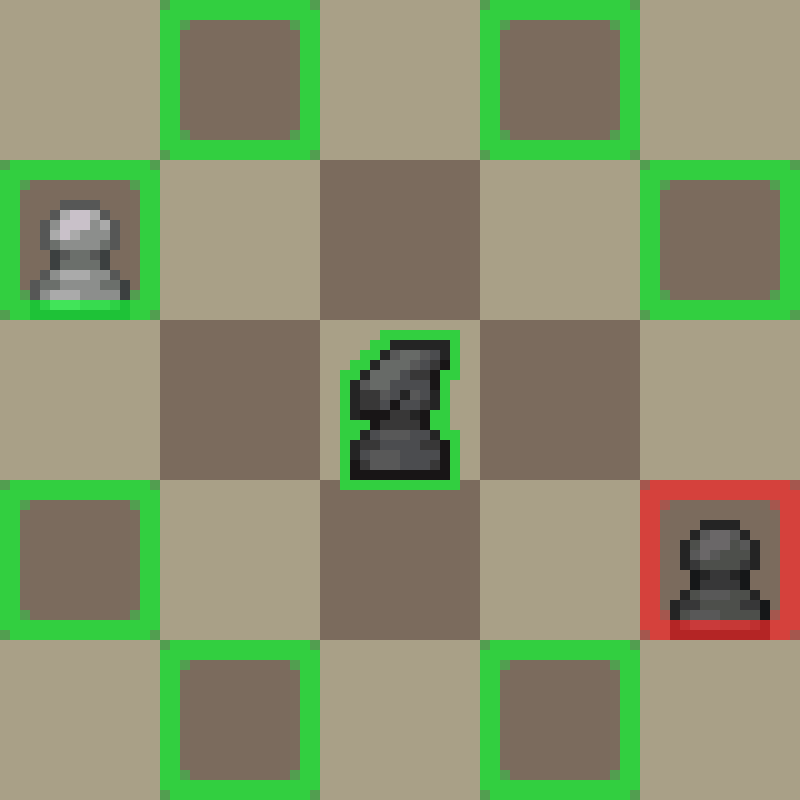
The knight is probably the simplest. In any of the 4 directions, it can move 2 squares, followed by 1 square to the side. Forming an L shape.
The “only” condition to this movement is that it cannot move to a square if it is occupied by a piece of the same color.
See? Simple enough.
function knightMoves() {
  knightOffsets = [
    (2, 1), (2, -1), ... (-1, 2), (-1, -2)
  ]

  for (offset in knightOffsets) {
    move = pos + offset
    if (move.onBoard() && !hasFriendlyPiece(move))
      validateSpot(move)
  }
}Implementation note, added after actually building this: the “only” condition above turned out not to be quite the only condition. During the attack-marking pass (see ‘In check’ below), a knight defending one of its own pieces still needs to mark that square, otherwise the enemy king is allowed to walk up and capture a piece that’s actually defended, since nothing ever recorded the defense. The long-range pieces already get an exemption from the friendly-piece check while attack-marking (see the note in the next section) - the knight needs the exact same exemption, it just doesn’t have a recursive trace to hang it off of:
if (hasFriendlyPiece(move) && phase !== ATTACK) return, same as everywhere else - including the king’s own adjacency check below, which didn’t get it either.
Long-range pieces
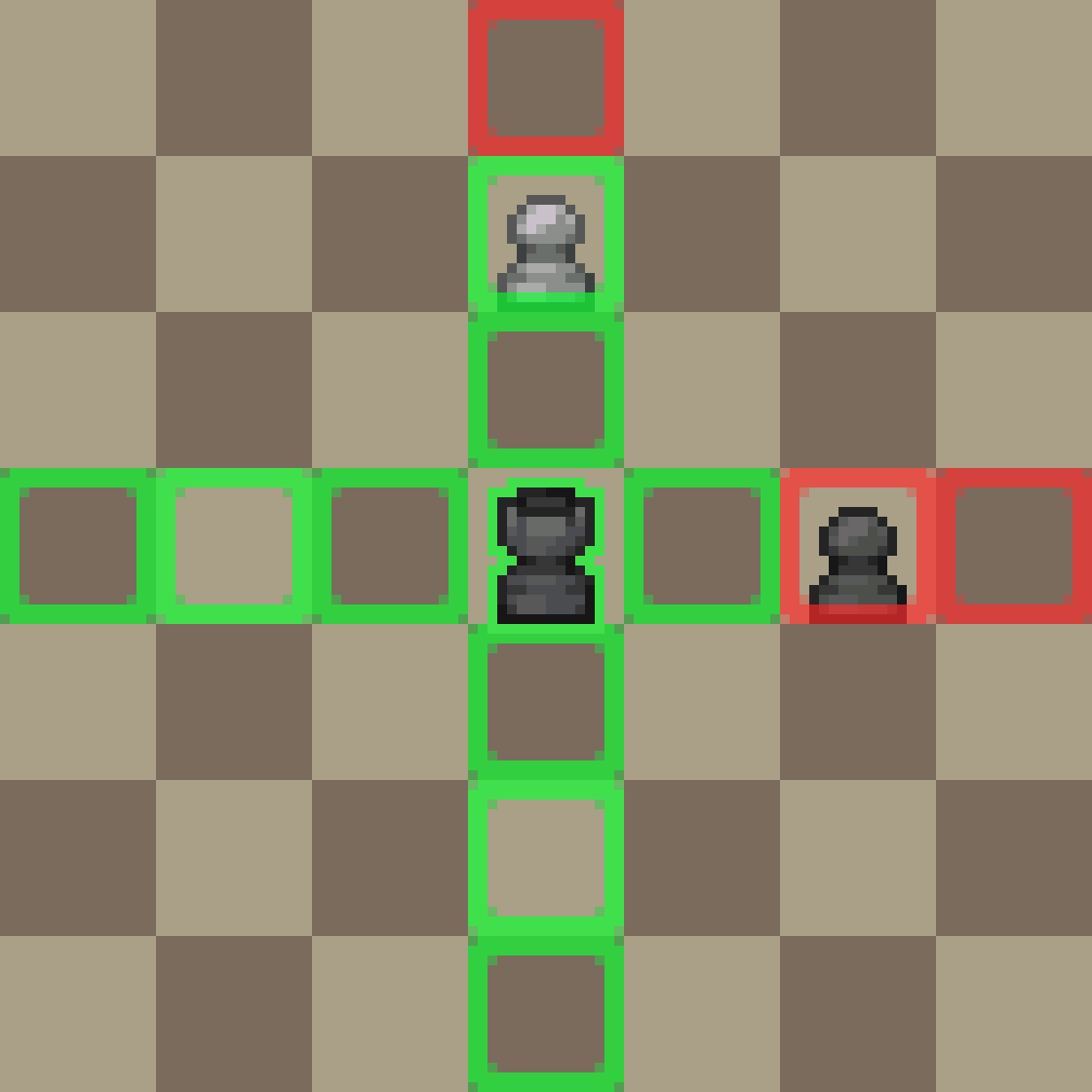
The long-range pieces—the queen, bishop and rook—also have quite simple movement patterns. In certain directions, they can move any distance as long as there isn’t a piece in between.
But, we have to pay attention here. Rays should stop at friendly pieces, but may capture enemy pieces.
The rook and bishop move in orthogonal & diagonal lines respectively:
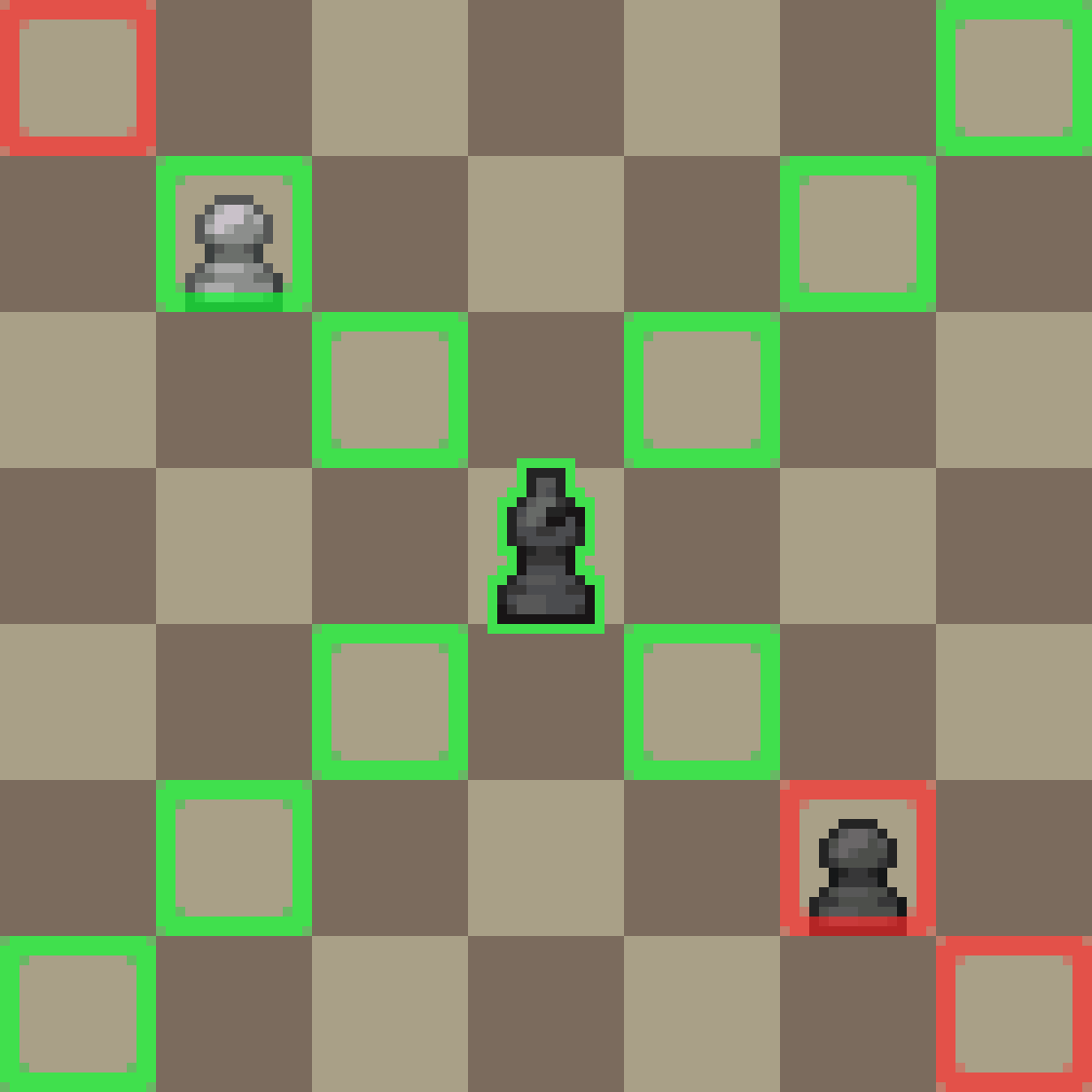
While the queen combines these two movesets, such that it can move in all 8 orthogonal and diagonal directions:
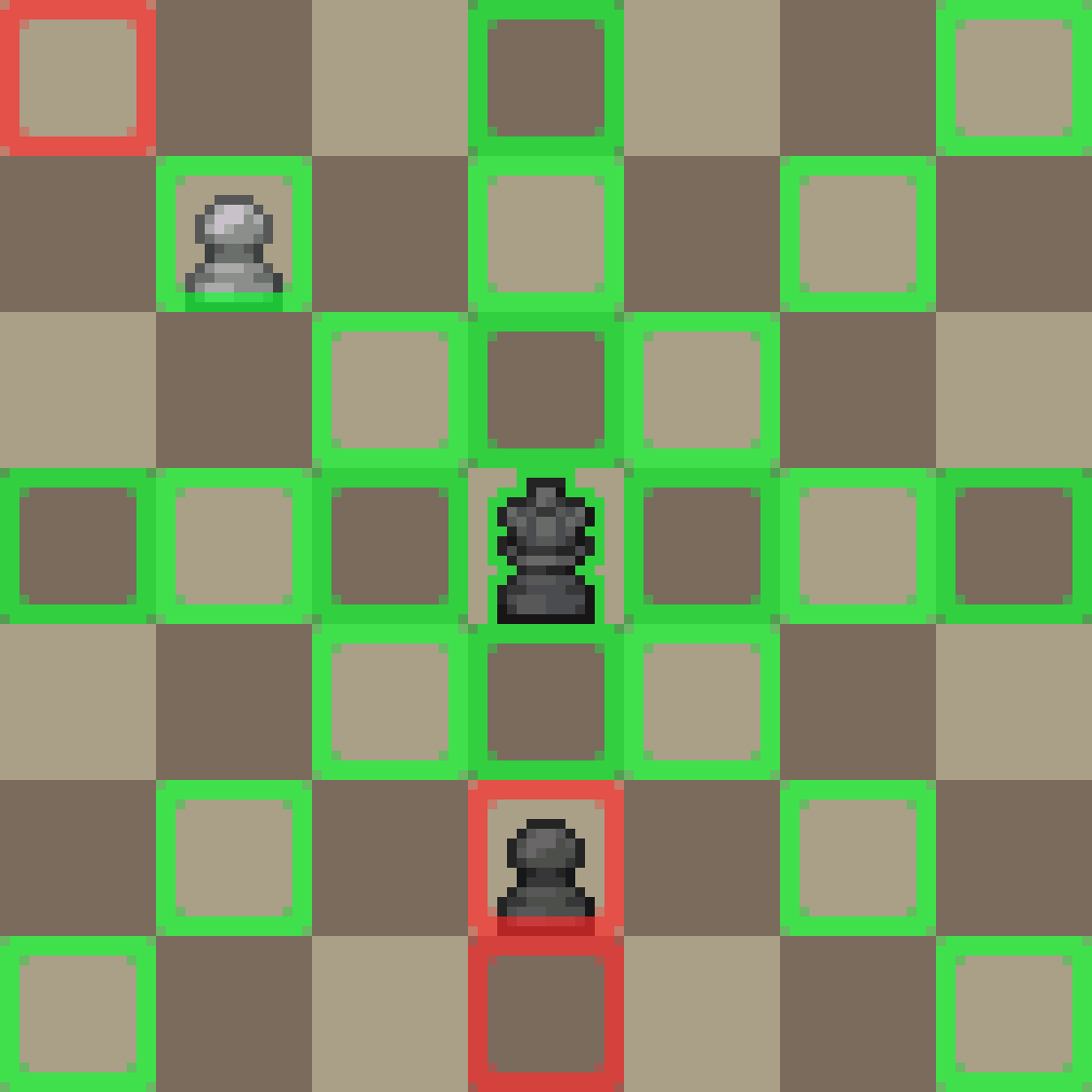
These long range moves can be evaluated quite easy. In all directions that these pieces can move, we can perform the following recursive algorithm to mark all valid spots:
// Pseudocode
function traceSpots(pos, dir) {
  if (hasFriendlyPiece(pos)) return // <- Remember this line

  validateSpot(pos) // Move or capture

  if (!hasPiece(pos.inFront))
    traceSpots(pos.inFront, dir)
}Pawns
The movement of a pawn seems really simple at first, but it’s actually the most complicated piece in terms of what moves it’s allowed to make, as it behaves different in multiple scenarios.
Excluding captures, the pawn can only move 1 square forward, except for when it hasn’t moved yet, in which case it may also move 2 squares forward. A pawn cannot move forward if the square is occupied by another piece, regardless of its color.
Unlike other pieces, the pawn is the only piece in normal chess that captures differently than how it moves. A pawn can only capture a piece that’s diagonally in front of it.
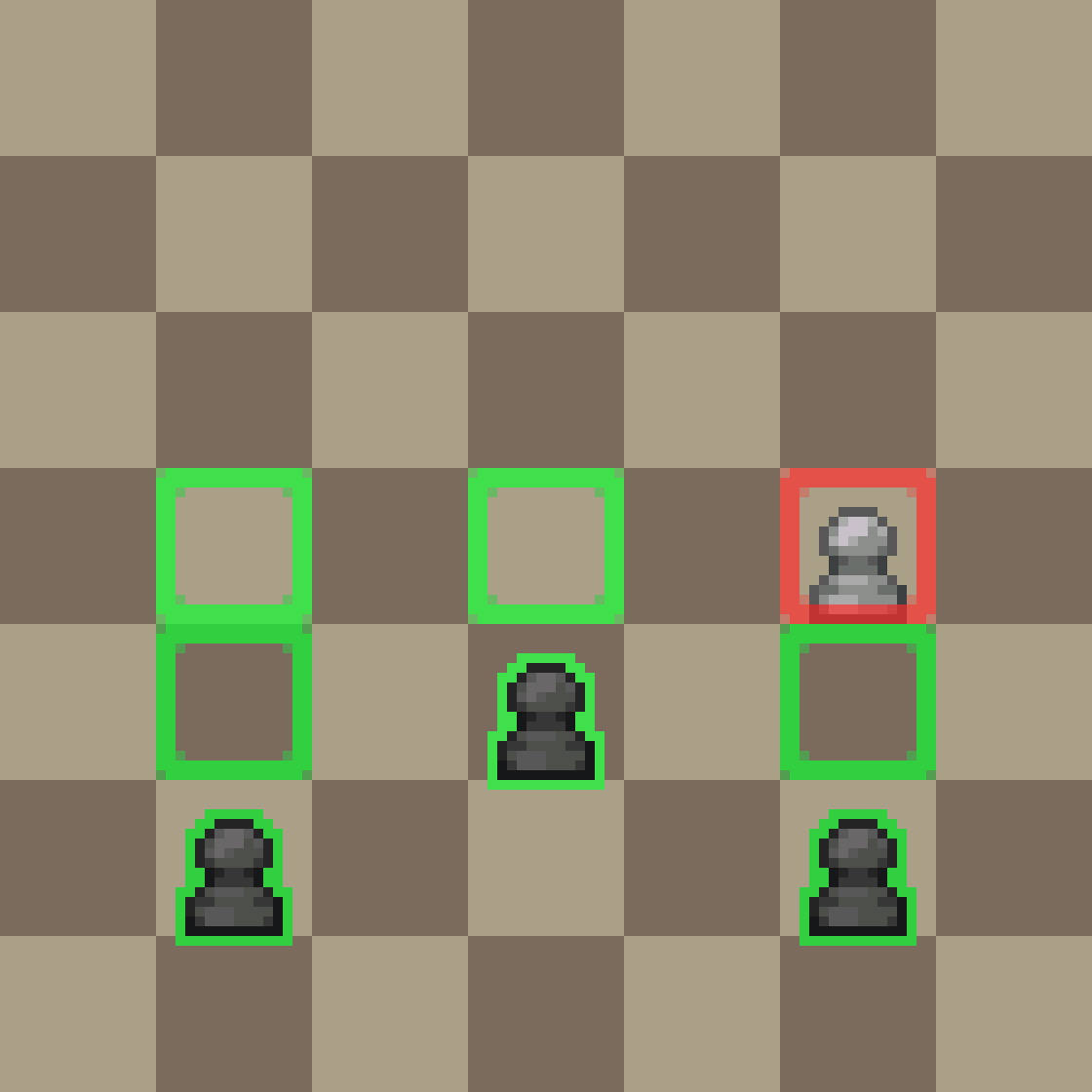
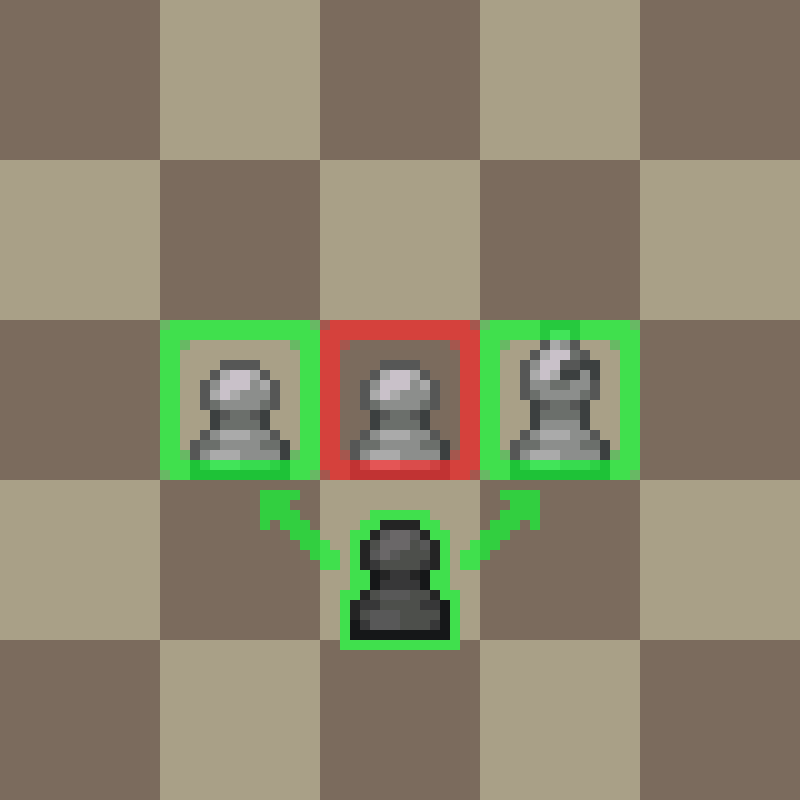
We can validate the moves of a pawn as such:
// Pseudocode
function pawnMoves(pos, dir) {
  // Simple moves
  if (!hasPiece(pos.inFront)) validateSpot(pos.inFront)
  if (!hasPiece(pos.inFront)
      && !hasPiece(pos.inFront.inFront)
      && !hasBeenMoved(pos)
  ) validateSpot(pos.inFront.inFront)

  if (hasEnemyPiece(pos.inFront.left)) validateSpot(pos.inFront.left)
  if (hasEnemyPiece(pos.inFront.right)) validateSpot(pos.inFront.right)
}Great, 5 pieces done, 1 to go.
The King
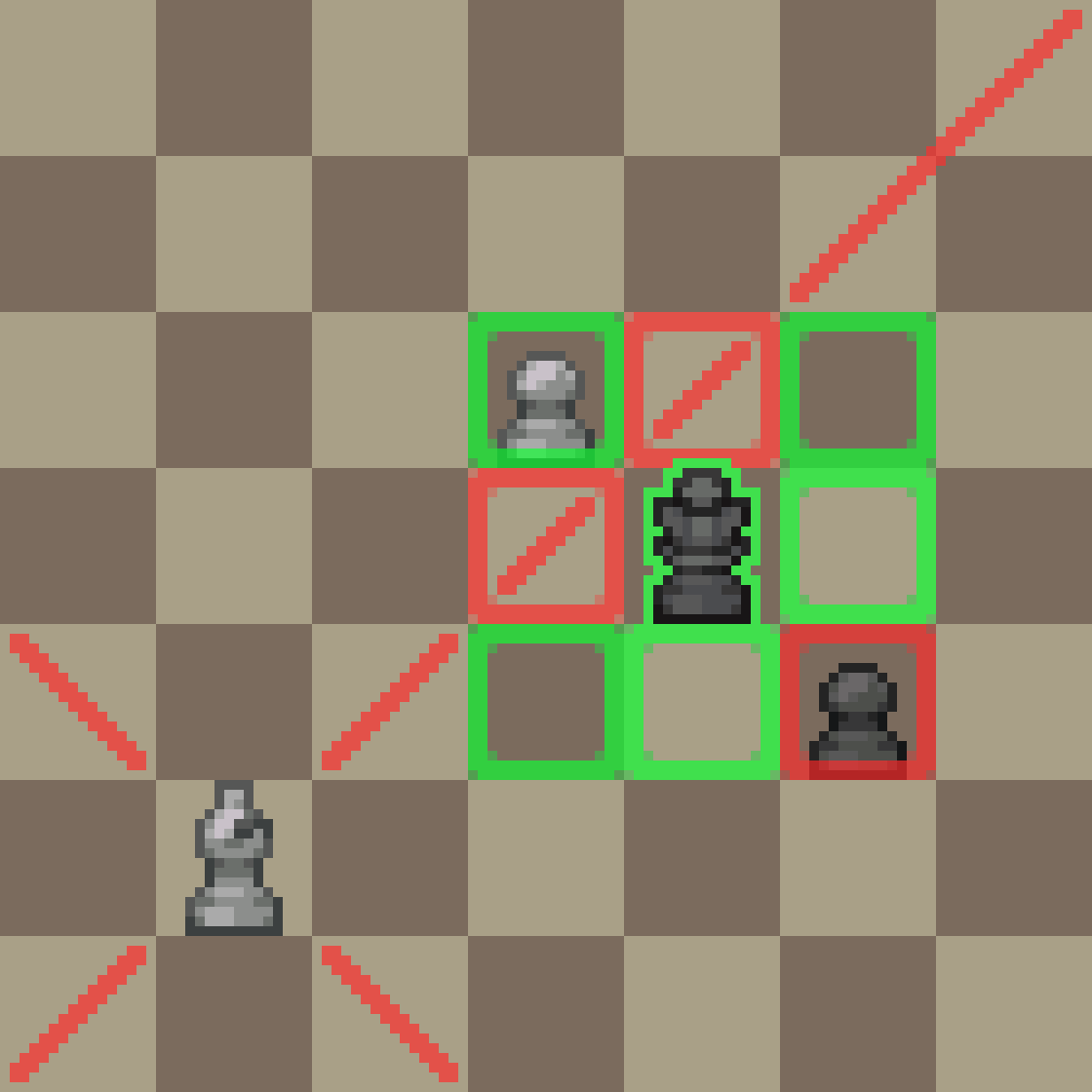
The king has a special condition that should be met for a move to be valid: The square can’t be attacked/defended by an enemy piece, as moving there would put the king in check.
The classic way to deal with this is: move the king to the square we’re trying to validate, then see if it is now in check, and if so, move back. But with our goal of static validation, we can’t do this. We have to detect whether a square is defended more efficiently.
Even then, detecting if a square is being attacked might sound really easy at first, but there’s still some considerations to be made. If we try to check if each of the king’s move squares if it is defended, we could look at all enemy pieces and see if they’re defending this square, for all 8 move squares.
This is obviously terrible, and we’re trying to create something somewhat efficient over here, so we have to find a more elegant approach. In the end, the best way to do this is marking which squares are attacked beforehand, so we only have to calculate it once for the entire board.
We can do this after every move. For each piece, this is what squares they attack:
- Knight: All valid move squares
- Long-range: All valid moves, plus squares with friendly pieces hit by rays. (So now in this case in our algorithm, squares should be validated regardless of the color of the occupying piece, so we can ignore the check in the long-range validation algorithm that I marked with a comment)
- King: All 8 adjacent squares
- Pawn: Diagonal-forward capture squares
Note that we don’t have to do this at the start of the game, as — in the normal chess configuration — none of the king’s adjacent squares can be attacked before at least a few moves are made, so the kings can’t move to a square that’s defended anyway.
We now have an algorithm to detect valid king moves, but it’s not perfect just yet. Let me give you the following example:
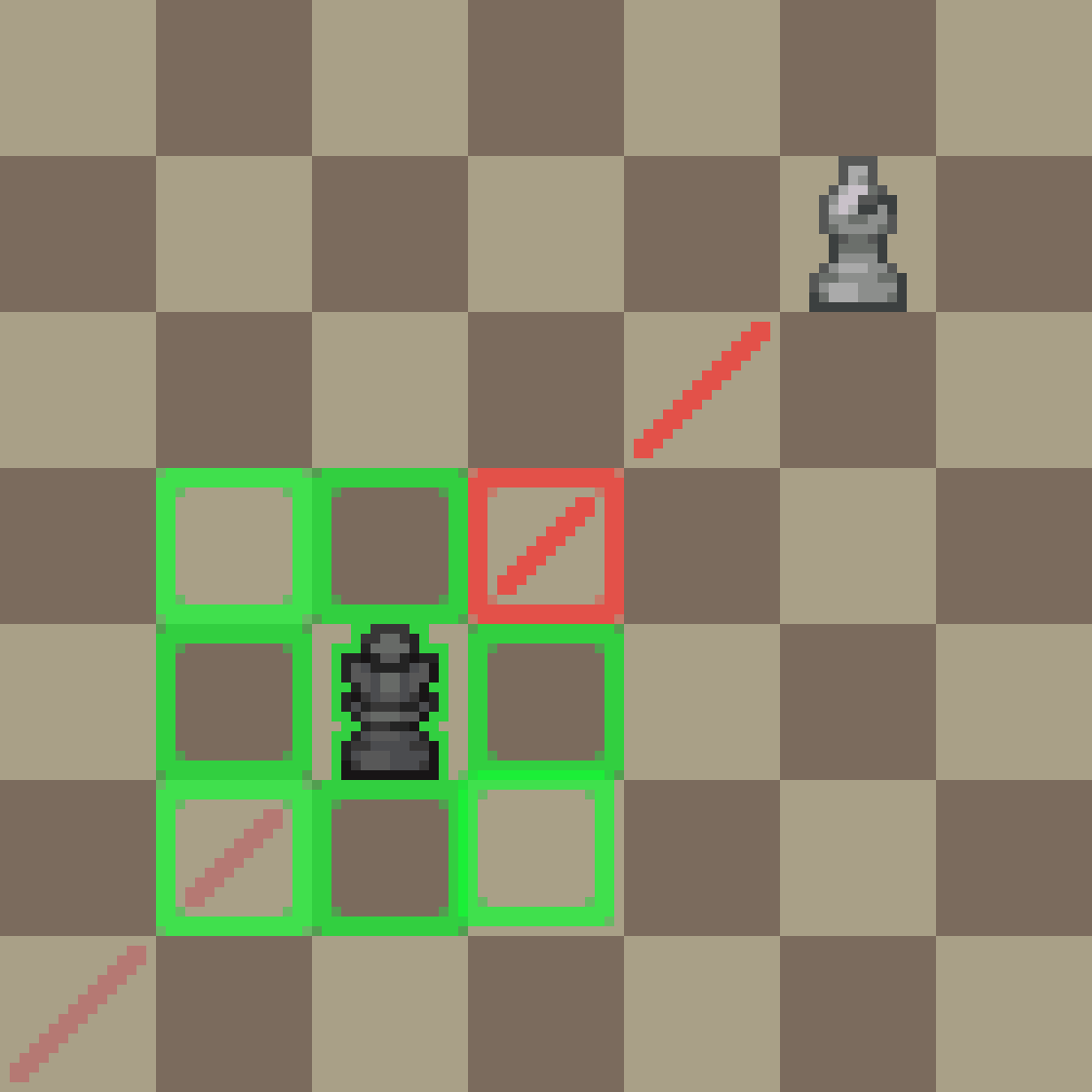
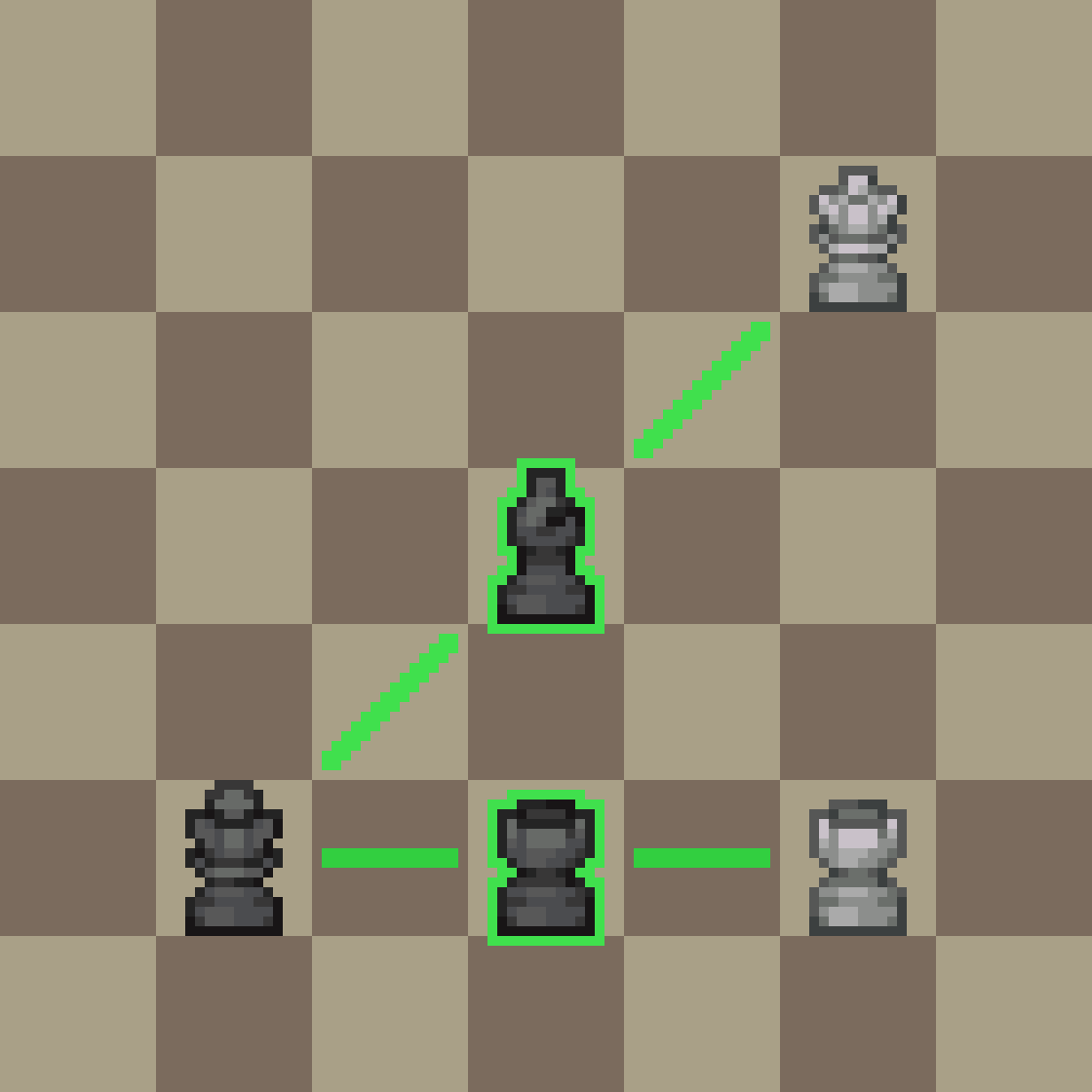
In our current algorithm, we only invalidated one of the move squares for the king—the top right—as it’s attacked by the bishop. However, if we were to move to the bottom-left square, our king would still be attacked! This isn’t allowed, so we must do something about this.
Luckily, the solution is really simple. In our recursive long-range piece function, we should simply pass through kings when we’re marking which pieces attack which squares. Now the king can’t escape the bishop by directly moving away from it.
Great! We now know pretty much how all pieces can move in normal chess! That’s already the biggest part out of the way. That was easy, right? Let’s move on to some less trivial considerations.
In check
Woah! Your opponent attacked your king. You’re now in check, what do we do?
Well the chess gods dictate that your only option is to get out of check. (if you even have options, but we haven’t gotten to that part yet)
How do we do this? There are exactly 3 ways to get out of check:
- Move the king to a square that is not attacked
- Block the line of check with a piece, such that the attacking piece no longer has direct sight on the king.
- Capture the piece that’s attacking the king, such that the threat vanishes.
HOWEVER, depending on the situation, not all of these options are actually valid ways of getting out of check. Let me present you with the following scenario:
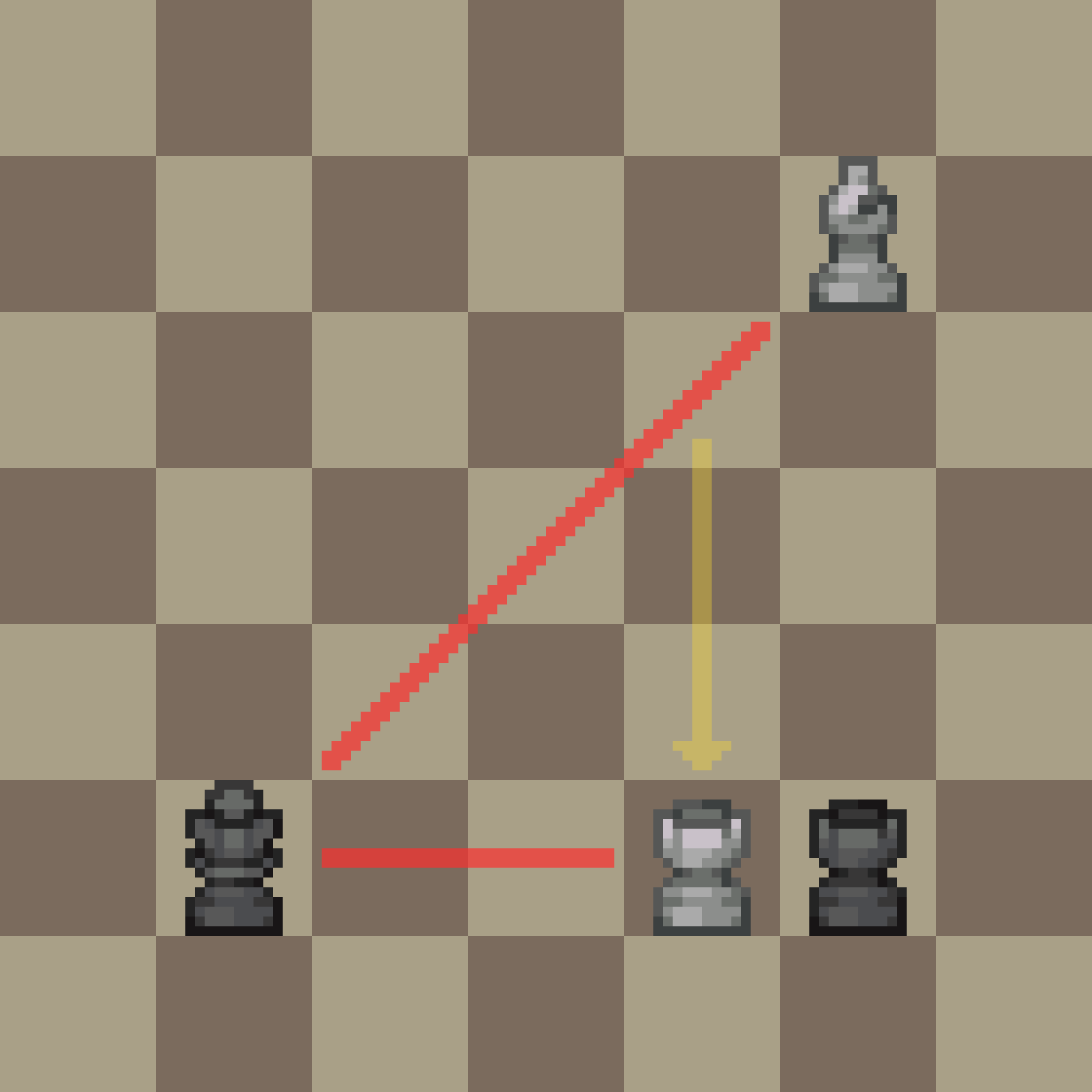
A white rook just moved to attack the king, which also revealed a bishop attack.
But we have a rook to capture the offenders! If we capture the rook, the bishop is still attacking the king. If we capture the bishop, the rook is still attacking the king. So wait, both of these moves are invalid!
Blocking also isn’t an option, as this is impossible when there’s two check lines.
This only leaves king moves to run to safety. And this is the case for any scenario where there are 2+ pieces attacking the king. In that situation you can’t use the last two check-evading methods. (though a king running to safety might still be able to still capture one of the pieces that put it in check)
If you have some free time, try to visualize for yourself why this is the case. Try finding a way to get out of a double check without moving the king, and reason why it’s impossible.
Alright, so let’s actually get to validating moves while we’re in check, that’s what we’re here for! We will explore all 3 methods outlined above.
Moving the king
This is always a valid way to get out of check (assuming there is a safe adjacent square to move to).
Lucky for us, we already handled this logic and thus validated these moves with the normal king movement logic, so we can skip it here!
Blocking the line of check
Like we outlined above, we can only do this if there’s exactly 1 piece checking the king, and this only applies if the attacking piece is one of the long-range pieces. Have fun trying to block check inflicted by a knight.
So in this scenario, we can validate any pseudo-valid move if it blocks the “line of check”. But how do we know that a move blocks this imaginary line? We should mark it beforehand again.
When tracing squares for long-range pieces, we can take advantage of the recursion by adding a line to the algorithm, and the validateSpot function:
function validateSpot(pos) {
  // ... existing code

  if (isOpponentKing(pos)) {
    checkOrigin = true // We're attacking a king, so we are a check origin
    markCheckOrigin(pos)

    // This is also a nice point to keep track of a variable to count
    // how many pieces are checking the king
  }
}

checkOrigin = false // Whether the current piece is checking the King
function traceSpots(pos, dir) {
  // ... existing code ...
  traceSpots(pos.inFront, dir)

  // Only mark squares lines of check when they're between you and the King
  if (opponentKing.distance(pos) < this.distance(pos)) return;

  // This will always run after the recursion
  // has ended, at all positions of the ray
  if (checkOrigin) markLineOfCheck(pos) // New!
}Now we know exactly what squares make up the line of check. We can use this pretty easily. When validating the move of a piece that isn’t the king, we will only allow this move if the move lands on a square marked as part of the line of check.
Capturing the attacking piece
This option also only applies to non-king pieces (if the King can capture it, we have already validated this move in option 1), when there’s exactly 1 piece checking. This makes it pretty similar to the case above, except instead of only validating moves that intersect the line of check, we validate moves that capture the checking piece.
For any moves generated by our piece movement algorithms, we can allow it if it captures the piece that is responsible for putting the king in check. Quite simple. For long-range pieces, we know what square is the origin of the check from the modification we made to validateSpot() in exploring the previous option. For other pieces we can simply mark its square as the origin of the check if one of its attacking squares is the enemy king.
Special moves
En passant
The En Passant rule was added to make our lives as developers difficult. It introduces a tricky exception to the movement of a pawn, where it can now capture pawns that just did a double move by jumping behind them. For one turn only, an opposing pawn may capture this piece as if it only moved forward one square.
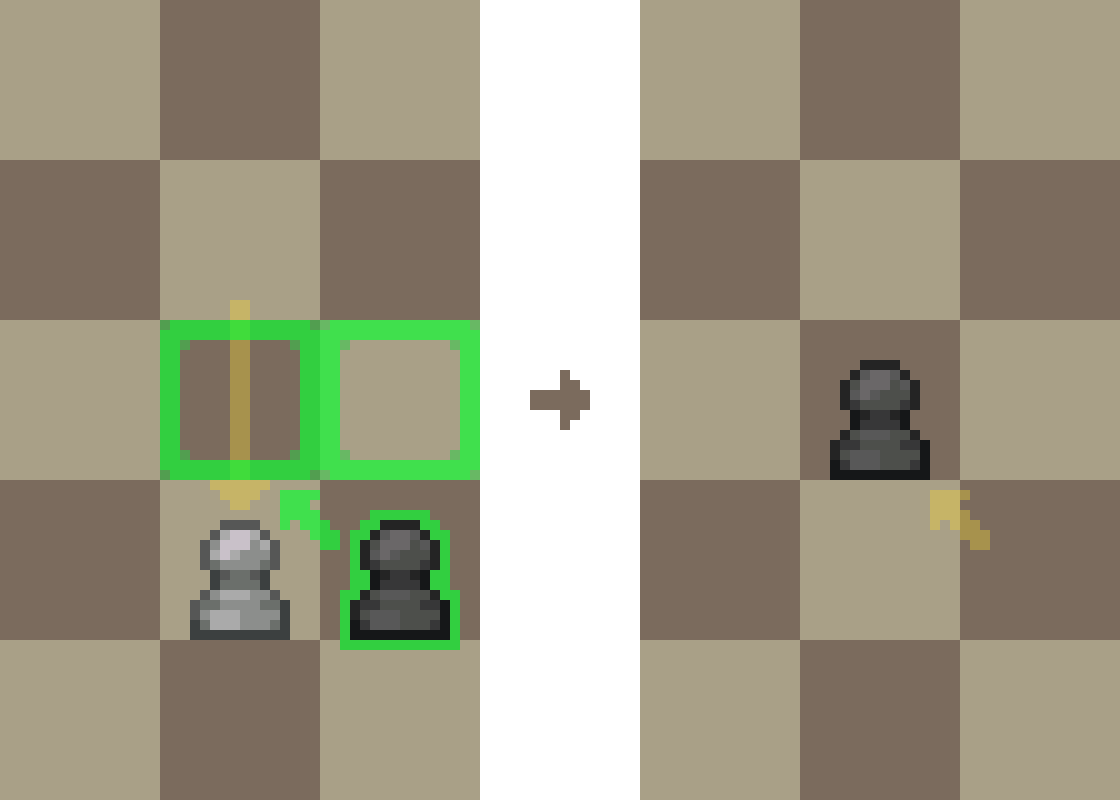
To detect these moves statically, we can:
- Track which pawn has just moved two squares.
- Mark said pawn as ‘En-Passantable’.
- An adjacent enemy pawn may treat the square behind the “En-Passantable” pawn as a valid capturing square.
We can implement this by extending our implementation of pawn moves:
function pawnMoves(pos, dir) {
  // ... existing code

  if (!hasPiece(pos.inFront)
      && !hasPiece(pos.inFront.inFront)
      && !hasBeenMoved(pos)
  ) {
    validateSpot(pos.inFront.inFront)
    markEnPassantable(pos.inFront) // <-- new
  }

  // En Passant
  if (isEnPassantable(pos.left)) validateSpot(pos.left.inFront)
  if (isEnPassantable(pos.right)) validateSpot(pos.right.inFront)

  // ... existing code
}But wait! If we move to the spot we just validated in the En Passant case, we still have to capture the En-Passantable pawn. In our static system it’s easiest to do this when the move is actually made. When the pawn moves, we can check if the new position is behind an En-Passantable piece, and if so, capture said piece.
Don’t worry, this isn’t the end of our En Passant troubles, it will return to haunt us.
Implementation note, added after actually building this: two things in the pseudocode above needed correcting once I wired it into a real engine.
Castling
Castling is a special move in chess, where in specific conditions, the king and a rook can swap around. To be specific, the king can move two squares at once sideways, and the rook will move to the other side of the king.
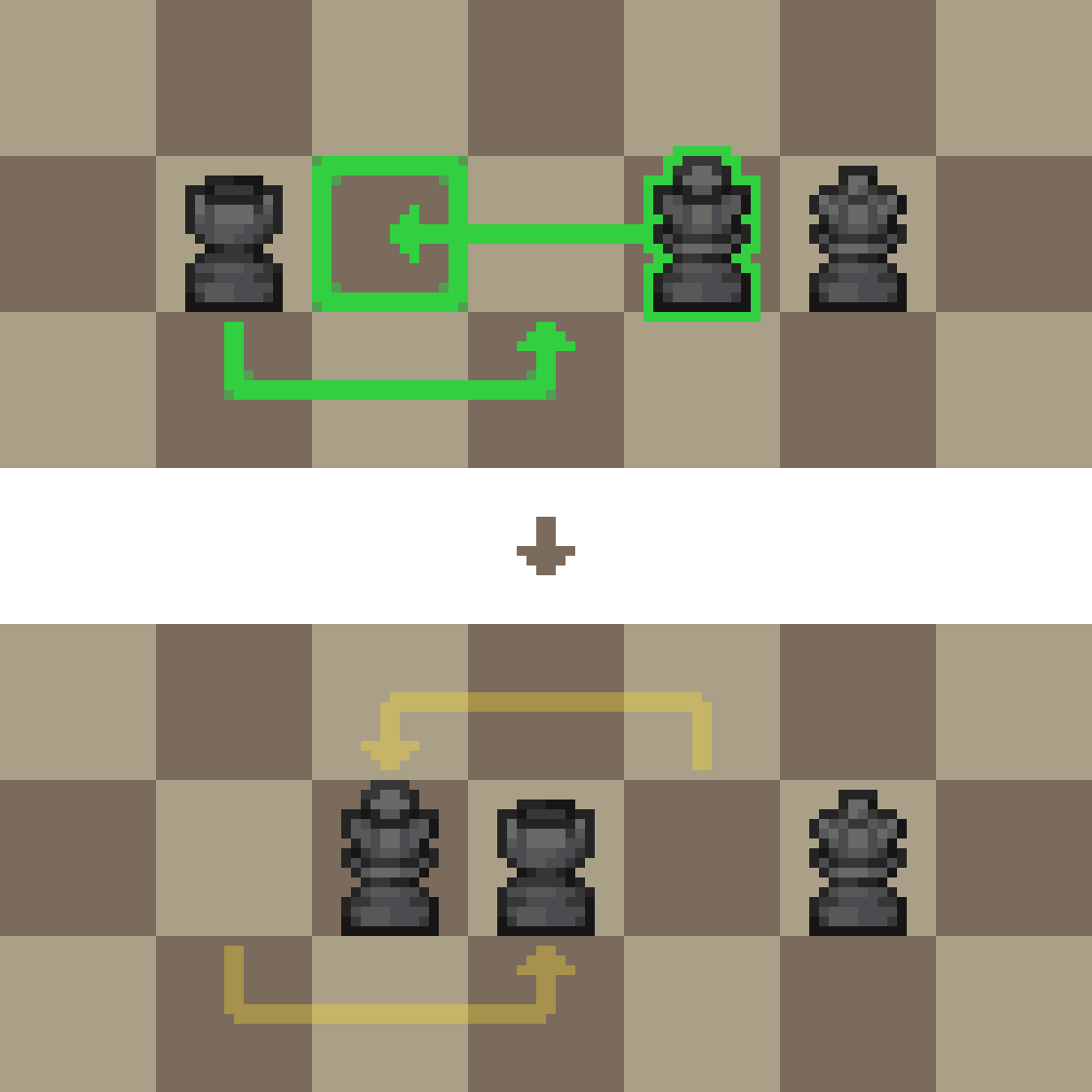
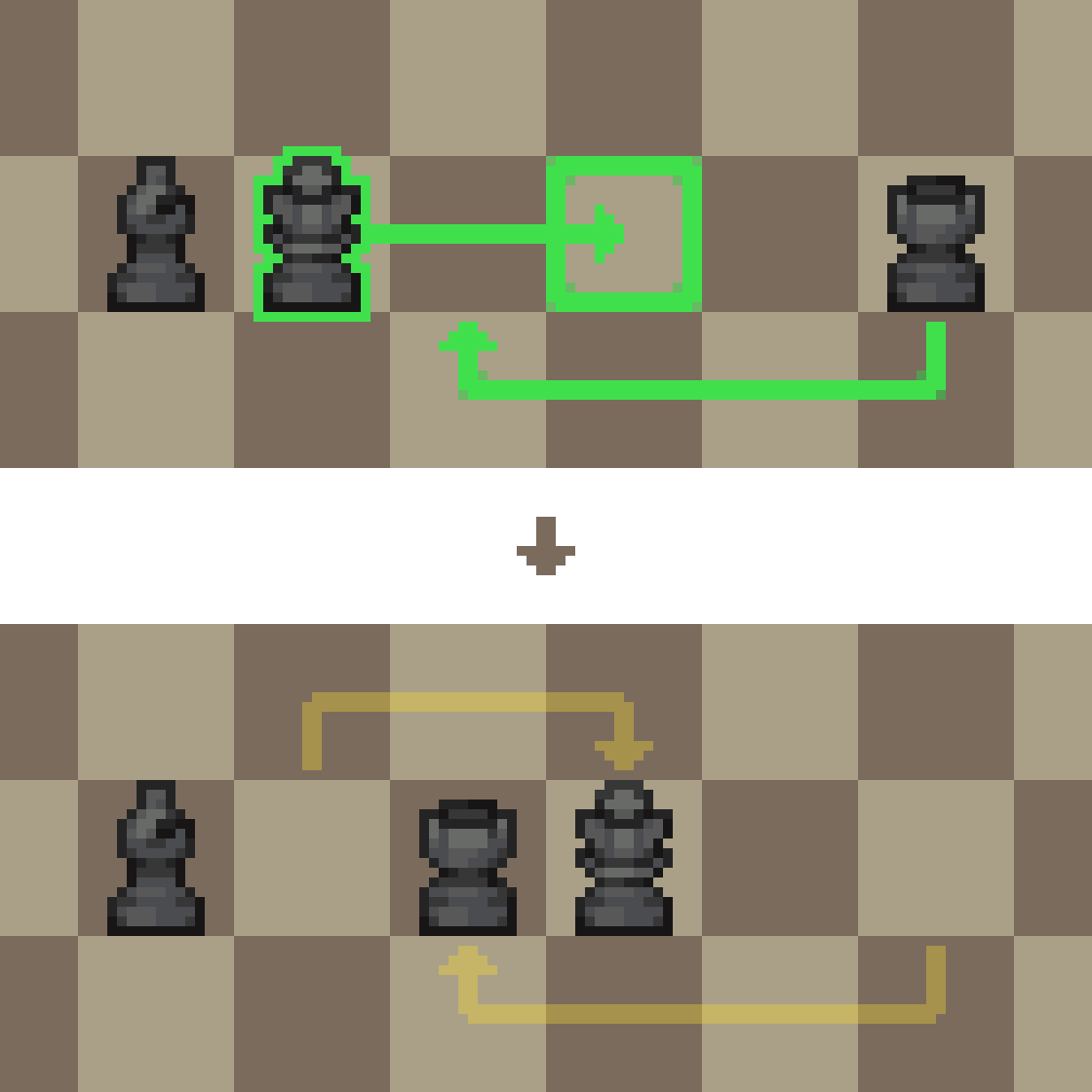
The conditions that have to be met for castling to a side to be possible are:
- The king has not moved.
- The rook on that side has not moved.
- The king is not in check.
- The two squares the king traverses are not attacked, and not occupied.
Given that we’ve marked what squares are attacked, this is pretty easy to implement.
function attemptCastle(pos, dir) {
  if (isAttacked(pos)
      || hasBeenMoved(pos)
      || hasBeenMoved(pos.find(dir, ROOK))) {
    return
  }

  if (hasPiece(pos.to(dir))) return
  if (hasPiece(pos.to(dir).to(dir))) return

  if (isAttacked(pos.to(dir))) return
  if (isAttacked(pos.to(dir).to(dir))) return

  validateSpot(pos.to(dir).to(dir))
}Using a function like .find() in this case could be an easy way to also check there are no pieces blocking the way to the rook.
We have to do one final thing to make castling functional: when the castling move is made, the rook should move to the other side of the king. We can implement this by checking if the last move was a double king move, and if so, teleport the nearest rook (from the new king position) to the other side of the king.
Promotion
Promotion is another fun rule in chess that usually comes into play in the final stages of a match. It allows a pawn that has reached the opposite edge of the board to ‘promote’ to one of the following pieces:
- A knight
- A bishop
- A rook
- A queen
This is a move that’s different from all others, as it essentially requires 1 extra input. Besides what piece you’re moving and where you’re moving it to, you also have to decide what piece to promote to, specifically after the pawn has moved.
Luckily for us, promotion is mandatory, so we don’t have to handle the case where a player decides not to promote.
An easy way to handle this is to, after moving a pawn, check if the position right in front of it is still on the board. If it isn’t, prompt the player to choose a promotion, and pause the game until that choice is made.
Pinned pieces
Pinned pieces are the next chapter in the book of headaches. Just kidding, they’re not that bad. So these pieces are special, because they are your king’s last line of defense against long-range pieces of your opponent.
In other words, pinned pieces are pieces that would have the potential to make a move that puts the king into check, which is of course not valid, so we have to take care of this.
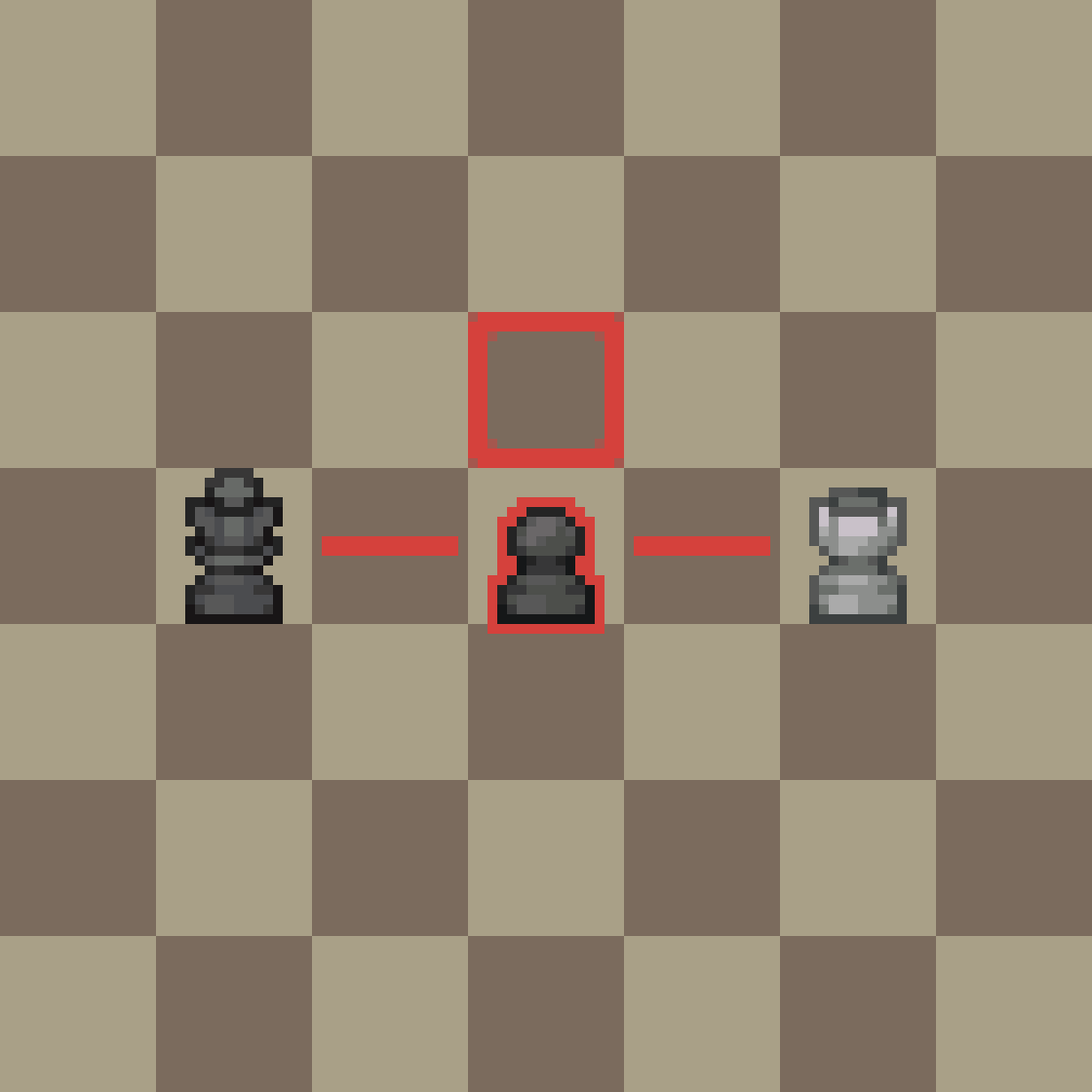
To start getting these pieces to follow the proper safety guidelines, we should first identify them!
Pin detection
This is where we have to make yet another modification to our long-range validation function.
The idea is this: When we hit an enemy piece that would stop the ray from going, instead of actually stopping, we “silently” continue the ray without marking new squares to be validated. We keep going until we hit a second piece. If this second piece happens to be the enemy king, we know that there’s only 1 piece in the way for our current piece that blocks an attack. That means that we can mark the first piece we hit as pinned.
firstHit = null
foundKing = false
function traceSpots(pos, dir) {
  if (hasFriendlyPiece(pos)) return // Friendly pieces still block

  if (hasEnemyPiece(pos) && firstHit != null) return // Second enemy piece
  if (hasEnemyPiece(pos)) firstHit = pos // First enemy piece

  if (isOpponentKing(pos)) foundKing = true // Remember the king was hit

  if (firstHit == null) validateSpot(pos) // Move or capture

  // ... existing code
}
// After tracing a direction
if (foundKing) markAsPinned(firstHit)It’s important for both this code and the code responsible for saving the line of check that the temporary variables are reset for each trace/direction.
Great, we now know what pieces are pinned!
Pin move validation
It’s surprisingly easy to validate moves for pinned pieces.
A potential move of a pinned piece may be validated if it lies on the same line as the current position and the king. In other words, from the current position, we move directly towards or directly away from the king.
This holds for all cases of a pinned piece, as it’s impossible to reveal an attack on the king by staying on the same line with the king as you currently are.
For my Minecraft implementation, a friend proposed a smart approach: validate moves by checking if the angle to the potential move matches the angle to the king from the current location. Move 1 unit in the first direction, then 1 unit back along the second; if I end up in the same spot, the move is on the line and therefore valid.
Edge cases
En Passant troubles II: Electric Boogaloo (the final part)
We’ve covered most situations that can happen in a game of chess, but there’s just a few board positions remaining that reveal flaws in our implementation. These are unlikely to happen in real games, but we should probably deal with them anyway.
En Passant check
Let me show you the following scenario, where a pawn that just moved two squares is also attacking the king.
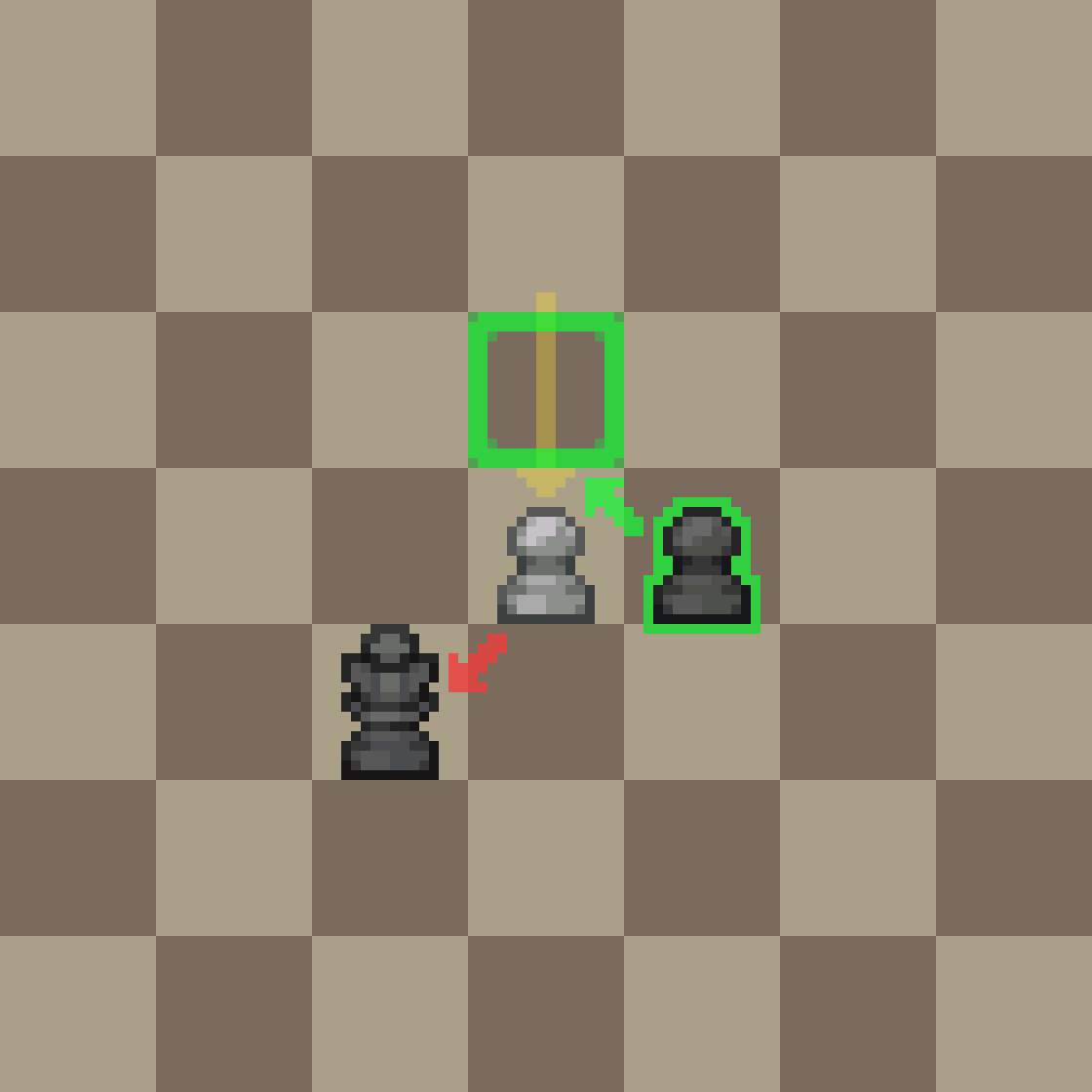
In this position, black should be able to capture the white pawn using the ‘Capture the attacking piece’ way to get out of check.
But This move is currently not being validated, because that pawn move isn’t going to the position of the captured piece.
So we have to create a special case for pawn moves in check so that it can also move behind an ‘En-Passantable’ ‘origin of check’ piece.
Implementation note: this wasn’t handled automatically for me. My check-evasion filter looks for a check-resolving mark on a move’s destination, but an En Passant capture lands on the skipped square, one rank from the checking pawn - so nothing marks it. Fix: when marking a pawn as a check origin, also mark the square behind it as a line-of-check square.
En Passant pseudo-pin
While looking into further possible edge cases I might have left unhandled, I found this scenario, in which another obvious issue with En Passant is highlighted.
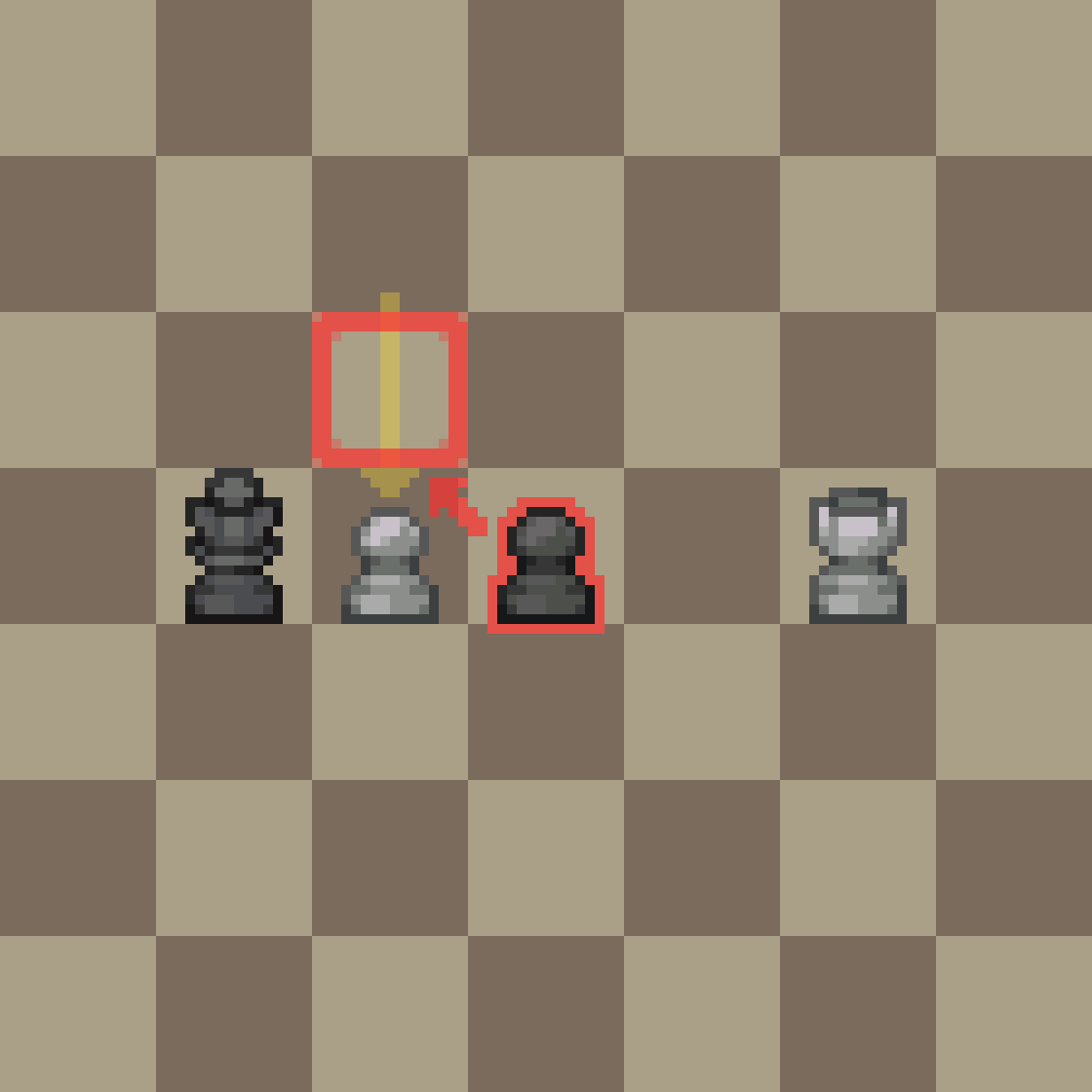
Turns out, capturing with En Passant is the only way to move a non-pinned piece while still revealing an attack on your king.
If the black pawn were to capture En Passant in this position, it would reveal a direct rook attack on the king.
So capturing En Passant here is not allowed! But because we detected no pinned pieces, we are allowing the pawn to move normally, including this illegal capture! So what do we do about this?
Well, we have to revisit our pin detection algorithm, to include this case.
If the very first thing a ray hits is an En-Passantable piece, we can treat it as if it wasn’t there and keep tracing - it’s still a real, currently-standing piece, so nothing past it counts as attacked yet, but it’s one that might vanish next move. If we then hit an enemy piece, and the king beyond that, we find ourselves in our edge case.
We can then mark that enemy piece as ‘En Passant pseudo-pinned’.
With that, we now know when one of our pawns managed to get itself in this predicament, and we can specifically not allow it to capture via En Passant in the next move.
Implementation note: the passthrough only makes sense the first time the ray hits anything - if some unrelated piece was already sitting between the attacker and the En-Passantable pawn, letting the ray see through it anyway would falsely flag that unrelated piece as pinned. And “seeing through” only means the ray keeps looking past it for a pin candidate, not that anything beyond it is already attacked - the pawn hasn’t actually been captured yet.
Mate & Stalemate detection
Mate and stalemate detection is actually quite easy to implement in our current system.
We already have a way of finding the valid moves for all pieces, so we can simply run this for all pieces and count how many valid moves there are for each side.
This is sufficient for finding when a player has no more valid moves, and from there on it’s a simple matter on whether their king is checked or not to decide whether it’s checkmate or stalemate.
That’s our mate detection system almost done already!
There’s just one issue remaining. It’s possible for a player to make a move, after which it would not be able to instantly make another move. This doesn’t count as stalemate, as you can’t move twice in a row. The enemy gets to move first, which can give you valid moves again, thus preventing stalemate.
We can fix this, and greatly improve performance, by only running this mate detection code for the enemy side of the player that just moved.
If we choose to mark all possible positions instead of just counting them, we can also re-use this to do a quicker look-up for the possible moves for any valid move. In that case, when selecting a piece to move, we already have all valid moves for it marked, so we can simply show them.
Game flow
Events and game phases
So with all of these puzzle pieces together, we can finally stitch together a game flow and start bringing this Chess game to life!
It basically comes down to this:
At the start of the game, we don’t have to do anything.
-
When a piece is selected, we run its validation logic to present the possible moves.
-
When a valid move square is selected, we do the following:
- Move the piece over, capture the piece that was at that location.
- Perform special move logic:
- En Passant
- Castling
- Promotion
-
After a move is made, we do the following:
- Make sure to forget how we marked squares/pieces last round.
- Check if the just-moved piece will be En Passantable next move.
- If a pawn just reached the back rank, stop here, and pause until they have picked a promotion and the piece has been transformed.
-
Post-move stuff:
- Compute what squares the last moved player is attacking.
- Count how many valid moves the enemy of last moved player can make.
- Determine if one of the players is in Checkmate or Stalemate.
- Switch whose turn it is.
There. That’s it.
To keep track of what phase we’re in, it’s useful to keep track of a global ‘game phase’ variable. I use the following phases:
- Validating moves
- Checking attack squares
- Counting valid moves (Very similar behavior to the first phase)
- Promoting (Waiting for a player to promote)
- Idle
- Game Over (Someone won, or a draw)
Putting it together
The functions described by the above 4 events are pretty basic. Though a few of the other functions in this blog are a bit more complex. They grew a rule at a time across this post, which is nice for following along but leaves you without a single place that shows the whole thing. Here they are complete, everything above included:
Starting off with pawn movement, including En Passant and the edge case handling.
function pawnMoves(pos) {
  if (phase == ATTACK) {
    // Always defends both diagonals, regardless of what's actually standing on them
    validateSpot(pos.inFront.left)
    validateSpot(pos.inFront.right)
    return
  }

  // Simple moves
  if (!hasPiece(pos.inFront)) validateSpot(pos.inFront)
  if (!hasPiece(pos.inFront) && !hasPiece(pos.inFront.inFront) && !hasBeenMoved(pos))
    validateSpot(pos.inFront.inFront)

  // Diagonal captures
  if (hasEnemyPiece(pos.inFront.left)) validateSpot(pos.inFront.left)
  if (hasEnemyPiece(pos.inFront.right)) validateSpot(pos.inFront.right)

  // En Passant, entirely skipped if we're 'Pseudo-pinned'
  pseudoPinned = isMarked(pos, PSEUDO_PINNED)
  if (!pseudoPinned && isEnPassantable(pos.inFront.left)) validateSpot(pos.inFront.left)
  if (!pseudoPinned && isEnPassantable(pos.inFront.right)) validateSpot(pos.inFront.right)
}Now let’s go over the function that’s used for the long-ranged pieces as well, as this function has a lot of different impotant parts.
These trace variables are for keeping track of the info in that specific trace, and thus must be reset in between each call
// Reset before every one of a piece's traces
firstHit = null
foundKing = false
checkOrigin = false
passedEnPassantable = false
blocked = false

function traceSpots(pos, dir) {
  // Treat an as-yet-uncaptured En-Passantable pawn as if it wasn't there, but only on the
  // very first thing this ray hits - an ordinary blocker further down the ray still blocks
  passingThrough = phase == ATTACK && firstHit == null && isEnPassantable(pos)
  if (passingThrough) passedEnPassantable = true

  // Friendly pieces still block movement, but not attack-marking (see 'In check')
  if (hasFriendlyPiece(pos) && phase != ATTACK) return

  if (isOpponentKing(pos)) foundKing = true

  // Stop on the second enemy piece hit, unless we're passing through an En-Passantable one
  isEnemy = !passingThrough && hasEnemyPiece(pos)
  if (isEnemy && firstHit != null) return

  // An En-Passantable pawn still blocks right now - track that separately from firstHit,
  // or everything past it would falsely count as attacked until something else stops the ray
  alreadyBlocked = blocked
  if (hasPiece(pos)) blocked = true
  if (isEnemy) firstHit = pos

  // Validate up through the first block as normal, but during Phase.ATTACK keep going past it if
  // that hit was the opponent king, so squares directly behind the king still get marked ATTACKED
  if (!alreadyBlocked || (foundKing && phase == ATTACK)) validateSpot(pos) // Move or capture

  // Anything solid that isn't an enemy (or an En-Passantable pawn) stops the ray here
  if (hasPiece(pos) && !isEnemy && !passingThrough) return

  traceSpots(pos.inFront, dir)

  // Only mark squares between us and the King, not behind it
  if (opponentKing.distance(pos) < this.distance(pos)) return

  if (checkOrigin) markLineOfCheck(pos)
}

// After tracing one direction to its end:
if (phase == ATTACK && foundKing && firstHit != null)
markAsPinned(firstHit, passedEnPassantable ? PSEUDO_PINNED : PINNED)There’s one more function that never got its own code block, even though it’s arguably the most important one: the validation function. Every movement function in this post calls it on every pseudo-valid square it finds, but it’s the one that actually decides whether that move survives. Tying together checks for being in check, and pinned pieces.
One thing worth knowing before reading it: a “move” here isn’t just a destination square. It’s a piece-shaped object that remembers both the square it’s testing ‘pos’ and the square the piece actually started on ‘pos.origin’. This matters below, since a pin is checked against the piece’s own square, not the square it’s trying to move to.
function validateSpot(pos) {
  if (!pos.onBoard()) return

  if (phase == VALIDATE_MOVES || phase == COUNT_MOVES) {
    // Pinned pieces may only move along the line to their own king (see 'Pinned pieces').
    // Checked against the piece's own square, not the destination we're testing
    pinned = isMarked(pos.origin, PINNED)
    if (pinned && !moveLinesUpWithKing(pos)) return

    // Double check: nothing but the king itself can move at all (see 'In check')
    if (checkCount >= 2 && pos.type != KING) return

    // Single check: only a move that blocks the line of check, or captures the checker, survives
    if (checkCount == 1 && pos.type != KING
        && !isMarked(pos, CHECK_LINE) && !isMarked(pos, CHECK_ORIGIN)) return

    // Everything above just filters pseudo-valid moves down to actually-valid ones.
    // What we do with a move that survives depends on why we're computing it at all
    if (phase == COUNT_MOVES) availableMoves++
    else markValid(pos)
  }

  if (phase == ATTACK) {
    // Mark this square as defended / attacked
    markAttacked(pos)

    if (pos.has(opponentKing)) {
      numberOfChecks++
      checkOrigin = true // From traceSpots(), will trace back

      markCheckOrigin(pos)

      // Edge case Nr.1
      if (pos.type == PAWN) {
        markLineOfCheck(pos.origin.behind)
      }
    }
  }
}Try the demo
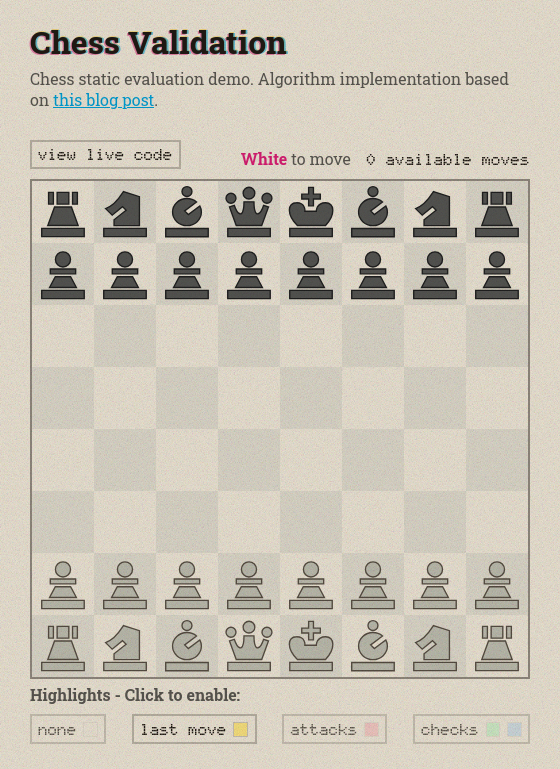
Now I genuinely would be surprised if you immediately wrapped your head around all this, so, if you’re thinking of implementing this algorithm, trying it hands-on, and looking at the code in total might help.
I’ve implemented the algorithm in its own typescript environment, so you can take a real and interactive look at this algorithm in action.
You will be able to see the markings update live as you move the pieces and read the source code as you go.
Take a look here:
Chess Validation DemoThis page is still relatively new. If you have any feedback or thoughts, I would love to hear them.
Conclusion
Thanks for reading!
If this blog was any use to you, or you have any thoughts, please shoot me a message! I would love to hear about your projects.
de Vries
de Vries