Tic Tac Tesseract is a play on the classic game Tic Tac Toe. Like the original, it's played by two participants who take turns placing a piece in an empty cell, trying to get 4 of their pieces in a straight line, while blocking the other player from doing the same.
Instead of a 3x3 board, we play on a 4x4 board, since a 3x3 would make it too easy to force a win. Unlike normal Tic Tac Toe, this version is played in 4 dimensions — a 4x4x4x4 board, for 256 cells in total. Trying to visualize this can be tough, so it's best not to try to wrap your head around the geometry, and just get used to the rules of the game instead.
For simplicity, let's start with a 3D board. You can probably imagine how a 3D game would work: 4 of the same piece stacked directly above each other would win. Here's an example:
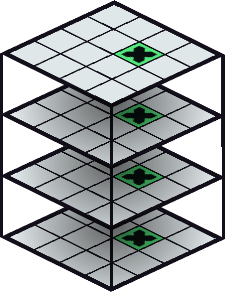 A straight line that goes directly up through a 3D board
You can see 4 crosses positioned directly below each other, one per level — a win for player X. We can also represent this as four 4x4 fields next to each other, like below. Think of them as floors of a building: each field is a floor of our 4x4 board. If every floor has your piece in the same spot, you win.
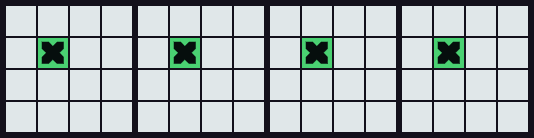 The same board represented as floors
If you've played Tic Tac Toe before, you know you can also make diagonal lines to win. Here's an example:
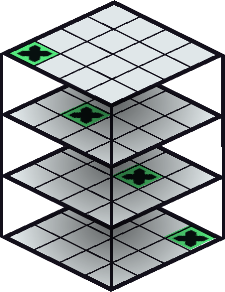 A straight line that goes diagonally up through a 3D board
 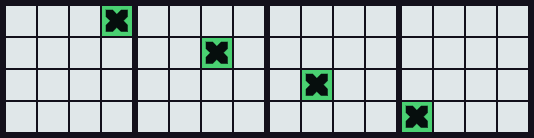 The same board represented as floors
Here's another example, where player O blocked player X from winning:
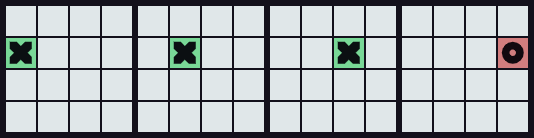 A line blocked by player O
Now that we've expanded into another dimension and flattened it out, we can repeat this process to expand into the 4th dimension. Imagine the bottom row of the following board is what we already established, and all rows above it are floors stacked on top of that board:
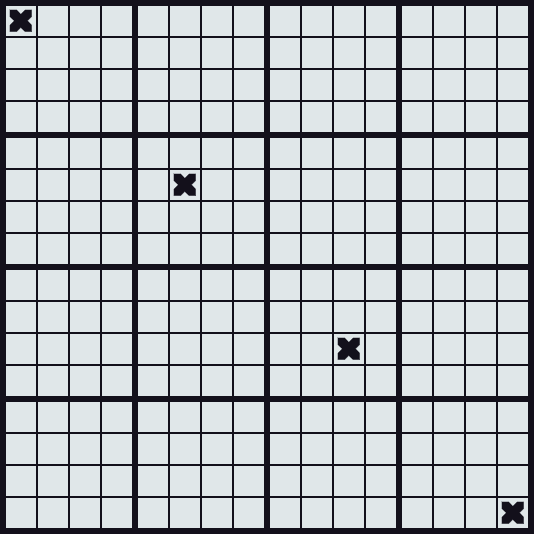 A line going diagonal in all directions
Here's what that looks like stacked on top of each other — our 4D board.
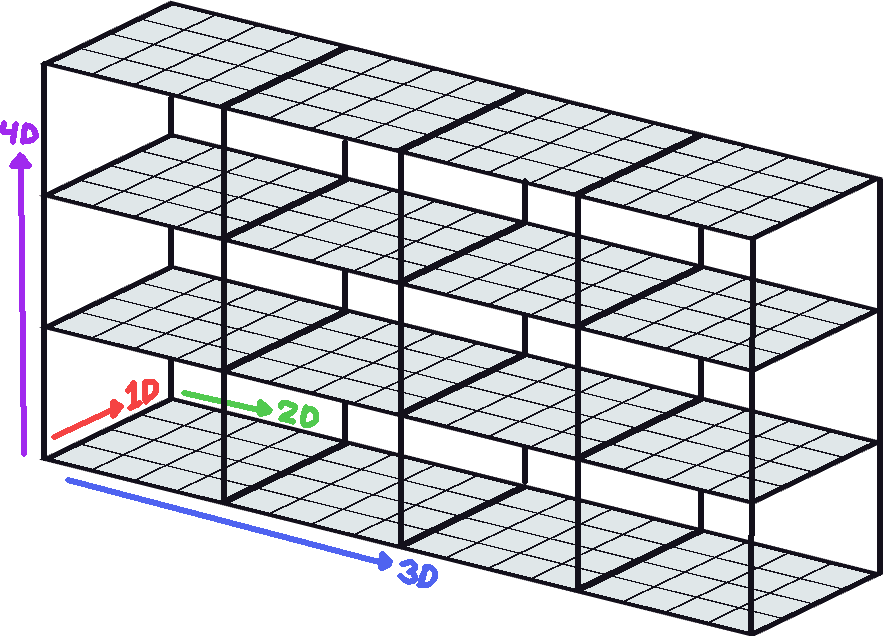 A 4D board represented as 4 3D boards
Here are some of the straight lines you could make on this board to win:
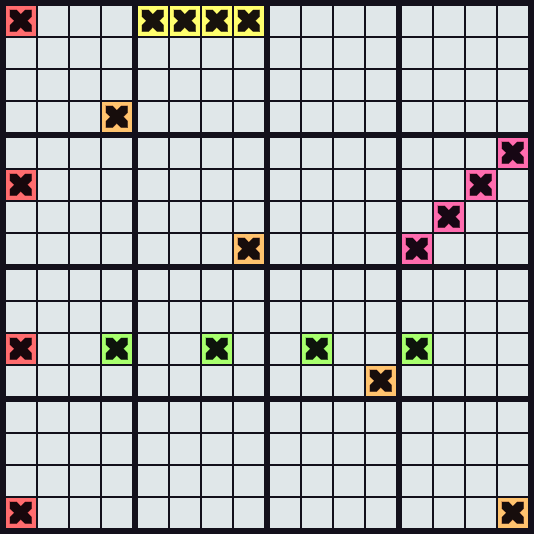 Examples of valid lines
To make the game easier to follow, the lines your hovered cell could be part of are highlighted like below. You can turn this off by clicking "disable highlights" below the board for an extra challenge — or add ?hard to the end of the url.
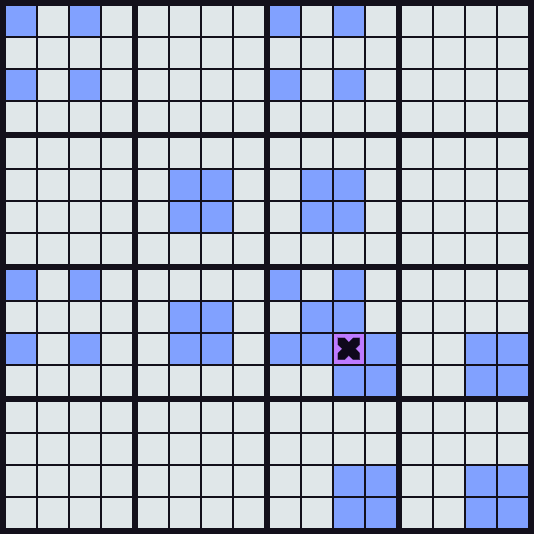 Highlights of lines the hovered cell could form
That's it! It's a confusing game at first, but it becomes much more intuitive as you get used to the rules. Here's an example of a real game where player X won:
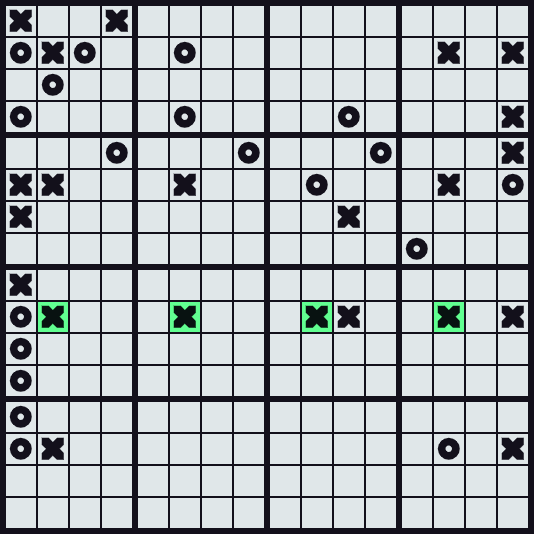 An example of a real game — player X won here
 Have fun playing!